
Live Shipping Estimates - Available Right Now

Live Shipping Estimates - Available Right Now

Hauling Heavy Equipment

Professional Gasoline Engine Shipping Services

Hauling and transporting gasoline engines nationwide

/>
Heavy Equipment Transport Logo

No Compromises. Full Results.

Speak with a logistics expert - we’ll handle
your transport from A to Z.

(888) 730-2951
Heavy Equipment Carriers
23,000+
Carriers
Nationwide
Freight Shipping
16+
Years of
Experience
Heavy Equipment
130+
Logistics
Experts

Shipping and Hauling Gasoline Engines

Gasoline engines power fleets, pumps, and equipment that can’t afford downtime. Shipping one can get tricky fast because fuel residue, oil, and coolant turn into leak risks and paperwork questions. We handle Gasoline engine hauling across the country, and we focus on clean prep, solid packaging, and the right service level so your engine arrives ready to work.

Shipping an engine

Call today to speak with one of our experts

(888) 730-2951

Gasoline Engine Shipping Fuel and Fluid Preparation

Fuel is the first checkpoint. An engine that still contains gasoline can fall under hazardous materials rules. Federal rules for internal combustion engines allow up to 500 mL of residual fuel in closed components if it can’t leak during transportation. In practice, most carriers want gasoline engines shipped as empty and dry as possible.

Oil and coolant matter too. Many freight programs require engines drained and capped. If a fluid can’t be fully removed, the package still has to be leakproof in any orientation. A leak at a dock or terminal can stop a shipment and trigger cleanup delays.

Large cab truck transport

Start your free quote now

Free Quote

Gasoline Engine Shipping that Survives Handling

Engines get damaged when they shift or get struck during forklift handling. We prefer the engine mounted to a solid base, with ports capped and loose parts packed separately.

Common setups include:

  • Bolted to a pallet with blocking and bracing.
  • Crated with internal supports that keep the engine from moving.

Wrap and banding help keep the load tight. Absorbent material under the engine can catch trace seepage from galleries or lines. If you’re shipping extras like starters, brackets, or ECUs, we pack them so they can’t bounce into the block.

Truck transport with expertise
Heavy Equipment Transport logo

Expertise you
can trust

Need specialized heavy equipment shipping?
Our logistics agents have the solutions you need.

16+ Logistics Experts
23+ Carriers Nationwide

Gasoline Engine Transport Options: LTL Versus Dedicated Hauling

Many gasoline engines ship as LTL once they’re palletized or crated. It can be cost friendly for lighter shipments that don’t need a full trailer. LTL also means more handling, so packaging has to be tough.

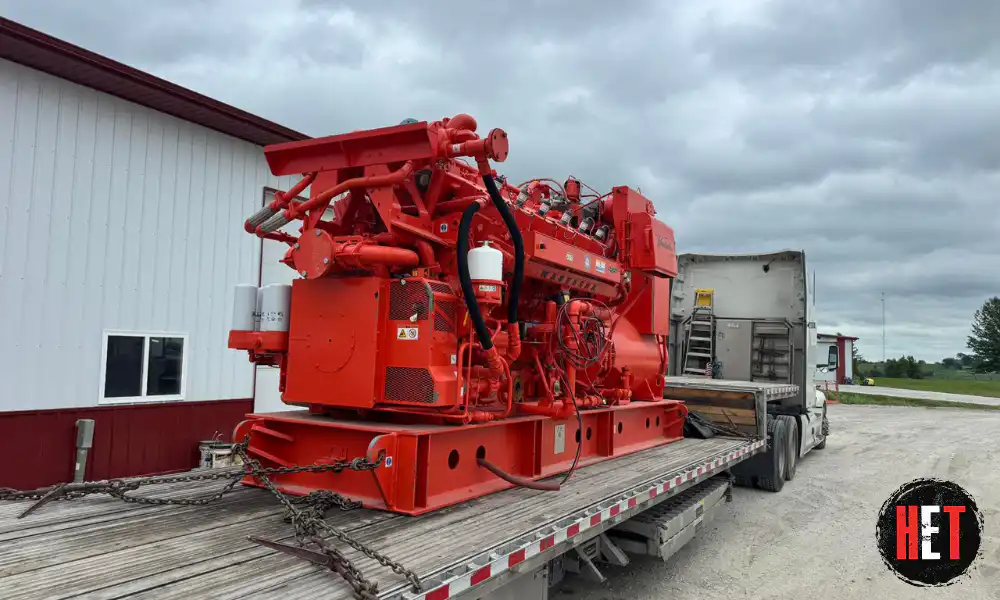
Dedicated or full truckload service makes sense for heavier engines, tight deadlines, or higher value freight. It also cuts down on handoffs between pickup and delivery. If an engine ships on an open-deck trailer, we plan securement around rated tiedowns and stable contact points so the load stays planted from mile one to the final unload.

The Gasoline Engine Shipping Process

We keep it straightforward. You get one point of contact from quote through delivery. We match the shipment to the right carrier and equipment, then we stay on top of scheduling and updates.

We’ll ask for dimensions, weight, packaging type, fluid status, and pickup and delivery access. Our team has more than 16 years in freight shipping, with a network of over 23,000 carriers and more than 130 logistics experts. If you need help with gasoline engine hauling, call (888) 730-2951.
Hauling heavy equipment

Heavy Equipment Transport Logo Talk to a Heavy Equipment Transport Specialist

Secure your transport today and see why we're the best
(888) 730-2951

Gasoline Engine Hauling With Fewer Headaches

Drain what you can, cap every opening, and mount the engine to a base that won’t flex. Share the real site details, including forklifts, cranes, and appointment rules. We’ll handle the carrier match and the shipping plan so your gasoline engines arrive on schedule and in good condition.

FAQ

Can gasoline engines be shipped without fuel or fluids?

Yes. Most shipments go out drained of gasoline, oil, and coolant, with ports capped. Federal rules allow up to 500 mL of residual fuel in closed components if it can’t leak during transportation, but many carriers still prefer fully drained engines.

Are small gasoline engines shipped differently than large engines?

Often. Smaller engines may ship by parcel or light freight if they meet size and weight limits. Larger engines usually ship as freight on pallets or in crates because they need forklift handling and stronger protection.

Do gasoline engine shipments qualify for LTL or require full truckload hauling?

Both are common. LTL works for palletized engines that don’t fill a trailer. Dedicated or full truckload service fits heavier shipments, urgent deadlines, or moves where you want fewer handoffs.

How are gasoline engines protected from leaks or damage during transport?

We focus on containment and immobilization. Engines are drained, capped, and secured to a pallet or inside a crate with blocking and bracing. Wrap, banding, and absorbent material help reduce damage and mess.

Can gasoline engines be transported across state lines without permits?

Yes, if the loaded vehicle stays within legal size and weight limits. Crossing state lines does not trigger oversize permits by itself. Separate hazardous materials handling rules can apply if fuel residue is present.