Tractor Trailer Axle Weights

Tractor Trailer Axle Weights

Heavy Equipment Transport Logo
Facebook
Twitter
LinkedIn

William Thomas / January 2021

When you’re moving something with a large trailer, there are rules that determine exactly how much weight per axle is allowed, both on a state and federal level. This is to help keep everyone safe and to protect the infrastructure that trucks and trailers drive on. To help you understand what the regulations are and how to better manage heavy shipping, this guide will walk you through the federal and state regulations for tractor trailer axle weights.

The Federal Formula Governing Tractor Trailer Axle Weights In Towing Industry

The Federal Highway Administration devised a formula called the bridge formula that defines the maximum load weight that a trailer with a given set of axles can carry when driving through interstate highways and major road routes in North America.  This formula was enacted to limit the weight to length ratio of a loaded trailer and truck towing a load across a bridge to reduce the toll on the infrastructure and ensure that the bridge can handle the truck’s load. The rule focuses on how closely spaced the axles are because the closer the axles are to each other, the higher the stress exerted on a road or bridge. By spreading the axles out, trucks can put less pressure on the national infrastructure. Another option is the trailer having additional axles.

The bridge formula uses these variables: The overall gross weight on a set of two pairs or more consecutive axles, the number of axles, and the length (in ft.) between a set of two axles and the outer axle. With the bridge formula, you can use the dimensions, and gross weight of your trailer, to determine the weight limit compliance of a single or multiple axle trailer. 

This is the formula:

W=500(LN/N-1 + 12N + 36)

W stands for the overall gross weight on two or more consecutive axles. L is the distance between the groups of axles. And N is the number of axles in the grouping. When you put all of these variables together, you can determine exactly how much weight is on each axle group in your truck or trailer. 

Here are the weight restrictions to compare against once you determine the W value:

  • • 20,000 lbs for a single axle trailer
  • • 34,000 lbs for trailers with tandem axles spaced between 40 to 90 in
  • • 80,000 lbs for the gross weight of a multiple axle trailer


However, the bridge formula isn’t the only tractor trailer axle weight restriction. There may also be state laws that adjust what’s allowed in that particular area, and it could differ from the federal bridge formula.

States Tractor Trailer Axle Weights Limits Regulations In Heavy Trucking

As mentioned above, all trucks towing heavy equipment on the interstate roadways must adhere to the federal bridge formula. Even though the federal government does not have the mandate to issue permits, any load that exceeds weight limits under the bridge formula must be issued with overweight permits. Since the federal government has allowed the states and provinces to enact their own set of regulations and restrictions, you need to find out the axle weight limits for each state so that you can plan well on distributing your load weight while trucking through each state’s highways.

For instance, for a single axle trailer, a weight limit of 25,000 lbs. is permitted when crossing Texas highways. Luckily, our logistics team at Heavy Equipment Transport knows each state and province laws and are ready to help you move your heavy equipment anywhere across North America, Mexico, and Canada.

Here’s a chart that breaks down the general rules for each of the 50 states.

STATE SINGLE AXLE DOUBLE AXLE GROSS WEIGHT
ALABAMA 20,000 lbs. 34,000 lbs. 80,000 lbs.
ALASKA 20,000 lbs. 38,000 lbs. Per FBF
ARIZONA 20,000 lbs. 34,000 lbs. 80,000 lbs.
ARKANSAS   20,000 lbs. 34,000 lbs. 80,000 lbs.
CALIFORNIA 20,000 lbs. 34,000 lbs. 80,000 lbs.
COLORADO 20,000 lbs. 36,000 lbs. 80,000 lbs.
CONNECTICUT 22,000 lbs. 36,000 lbs. 80,000 lbs.
DELAWARE 20,000 lbs. 34,000 lbs. 80,000 lbs.
DISTRICT OF COLUMBIA   21,000 lbs. 37,000 lbs. 79,000 lbs.
FLORIDA 20,000 lbs. 40,000 lbs. 80,000 lbs.
GEORGIA   20,340 lbs. 34,000 lbs. 80,000 lbs.
HAWAII   22,500 lbs. 34,000 lbs. 80,000 lbs.
MISSISSIPPI 20,000 lbs. 34,000 lbs. 80,000 lbs.
MISSOURI 20,000 lbs. 34,000 lbs. 80,000 lbs.
IDAHO 20,000 lbs. 34,000 lbs. 80,000 lbs.
ILLINOIS 20,000 lbs. 34,000 lbs. 80,000 lbs.
INDIANA 20,000 lbs. 34,000 lbs. 80,000 lbs.
IOWA 20,000 lbs. 35,000 lbs. 80,000 lbs.
KANSAS 20,000 lbs. 34,000 lbs. 80,000 lbs.
KENTUCKY 20,000 lbs. 34,000 lbs. 80,000 lbs.
LOUISIANA 20,000 lbs. 34,000 lbs. 80,000 lbs.
MAINE 20,000 lbs. 34,000 lbs. 80,000 lbs.
MARYLAND 20,000 lbs. 34,000 lbs. 80,000 lbs.
MASSACHUSETTS   18,000 lbs. 34,000 lbs. 80,000 lbs.
MICHIGAN 20,000 lbs. 34,000 lbs. 80,000 lbs.
MINNESOTA 10,000 lbs. 34,000 lbs. 80,000 lbs.
MONTANA 20,000 lbs. 34,000 lbs. 80,000 lbs.
NEBRASKA 20,000 lbs. 34,000 lbs. 80,000 lbs.
NEVADA 20,000 lbs. 34,000 lbs. 80,000 lbs.
NEW HAMPSHIRE 20,000 lbs. 34,000 lbs. 80,000 lbs.
NEW JERSEY 20,000 lbs. 34,000 lbs. 80,000 lbs.
NEW MEXICO 21,600 lbs. 34,200 lbs. 80,000 lbs.
NEW YORK 20,000 lbs. 34,000 lbs. 80,000 lbs.
NORTH CAROLINA 20,000 lbs. 38,000 lbs. 80,000 lbs.
NORTH DAKOTA 20,000 lbs. 17,000 lbs. 80,000 lbs.
OHIO 20,000 lbs. 34,000 lbs. 80,000 lbs.
OKLAHOMA 20,000 lbs. 34,000 lbs. 80,000 lbs.
OREGON 20,000 lbs. 34,000 lbs. 80,000 lbs.
PENNSYLVANIA 20,000 lbs. 34,000 lbs. 80,000 lbs.
RHODE ISLAND 22,400 lbs. 36,000 lbs. 80,000 lbs.
SOUTH CAROLINA 10,000 lbs. 35,200 lbs. 80,000 lbs.
SOUTH DAKOTA 20,000 lbs. 34,000 lbs. 80,000 lbs.
TENNESSEE 20,000 lbs. 34,000 lbs. 80,000 lbs.
TEXAS 20,000 lbs. 34,000 lbs. 80,000 lbs.
UTAH 20,000 lbs. 34,000 lbs. 80,000 lbs.
VERMONT 20,000 lbs. 34,000 lbs. 80,000 lbs.
VIRGINIA 20,000 lbs. 34,000 lbs. 80,000 lbs.
WASHINGTON 20,000 lbs. Per state weight table 80,000 lbs.
WEST VIRGINIA 20,000 lbs. 34,000 lbs. 80,000 lbs.
WISCONSIN 20,000 lbs. 34,000 lbs. 80,000 lbs.
WYOMING 20,000 lbs. 34,000 lbs. 80,000 lbs.

Understanding Tractor Trailer Axle Weights In Heavy Equipment Delivery

Understanding axle weights in the heavy machinery moving industry is the key to seamless trucking services. A standard trailer has steer axle, drive tandem, and trailer tandem axles. These help spread out the weight of the load. Other tractor trailer axle configurations include tri-axle (three axles), quad-axle (four axles), and single-axle (one axle). No matter the configuration, the way the weight is distributed depends on the axle weight, axle spacing, gross weight, tire width, and ratings from the manufacturer.

With a better understanding of the tractor-trailer axle weights, a towing company will always operate within the law as well as minimizing tear and wear caused by “poor” distribution of weight.
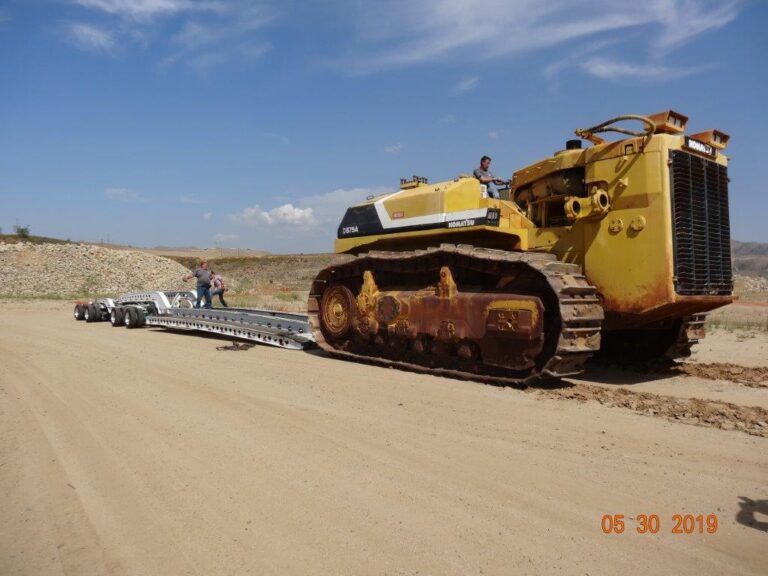
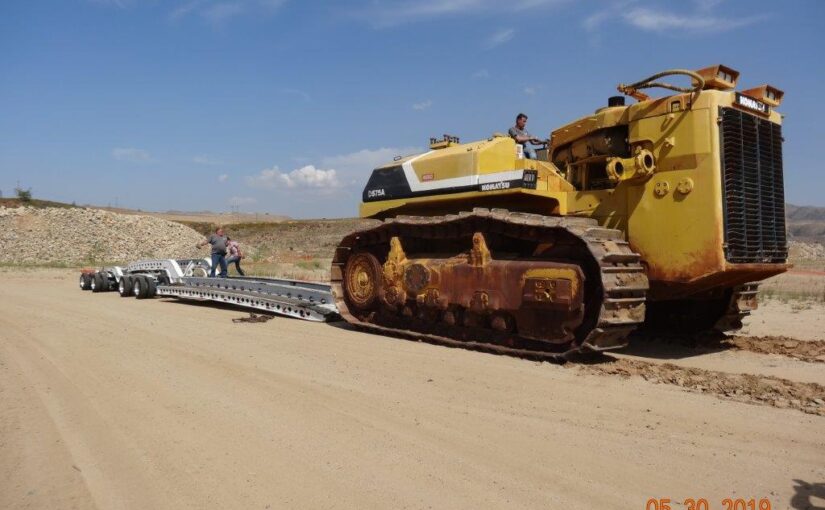
crawler dozer being loaded on trailer

Transport Your Tractor Trailer Today

Heavy Equipment Transport is always available for a quote. Fill out the form or give us a call now! (888) 730-2951

Factors Affecting Tractor Trailer Axle Weights When Trucking Heavy Loads

Although the gross weight does not depend on the weight transfer, the following factors will affect weight distribution across the axles of the trailer:

  • • Repositioning your trailer’s tandem axles.
  • • Sliding your trailer’s 5th wheel, either backward or forward
  • • Positions of the fuel tanks and the amount of fuel stored in the tanks
  • • The front-to-back lateral position of the load in the trailer
  • • The position of the center of gravity of the load in relation to the gross weight.

Why Do Tractor Trailer Axle Weight Limits Matter?

These limits exist to keep everyone safe and to protect the roads and bridges regularly used in routes. As a shipment weight approaches and exceeds the limit of 80,000 lbs, the overall risk of moving that load also increases. That’s why both national and state governments have put limits on these metrics. If you don’t follow the limits, that can lead to fines, delays, and even liability should your load cause any damage. 

It’s important to only move your heavy equipment using a hauler who follows these regulations to protect your machinery and stay within legal limits.

Transport Your Heavy Equipment Today

Heavy Equipment Transport is always available for a quote. Fill out the form or give us a call now! (888) 730-2951 | Start Quote
What are Outriggers on a Trailer?

What are Outriggers on a Trailer?

Heavy Equipment Transport Logo
Facebook
Twitter
LinkedIn

William Thomas / January 2021

Outriggers on a Trailer Used For Shipping Heavy Equipment

To haul a tractor with a lowboy trailer that is 1.5 ft. narrower than the tractor, you need to attach special equipment that acts as an expansion support system. Such equipment is called an outrigger and is used to increase the surface area of the trailer deck so that the trailer can support wider heavy equipment. Outriggers are very useful when shipping heavy machinery that have wider separations between the wheels. They make trailers become more versatile and help trucking and delivering heavy and wider loads efficiently and safer.

When it comes to wheeled agricultural heavy equipment hauling, it’s a common occurrence to see trailers use outriggers. The reason why heavy equipment transport experts use outriggers on a trailer is twofold. First, outriggers are used to widen the base of the trailer for stability reasons. They make the heavy equipment harder to tip over or rollover during hauling. This means that the trailer can carry heavier and wide equipment without compromising safety. Secondly, the outriggers are used to hold the wheeled heavy machinery rigidly. If the outriggers are not used, parts of the heavy equipment will be suspended on the edges of the trailer. Which means, the strains and chains used to secure the load will be under high tension when the truck hits the road. As such, the heavy equipment transport will be at risk of wobbling back and forth as the truck accelerates, moves on an even terrain, and breaks. With outriggers in place, it will be difficult for the heavy machinery to swing back and forth, making the trucking and towing smooth and safe.

How are Outriggers Fitted on a Trailer for Safe Shipping

Outriggers, commonly known to most trucking specialists as trunnion or trunnions, are load-bearing equipment that can either be pull out, swing out or attached type. The pull out outrigger is usually made of forged steel in a wedged shape to allow indexing at a right angle. The pull-out is designed with a mounting base that fits in the access spaces on the sides of the trailer. The mounting base features upper and lower mounting brackets and three locking positions for flexibility.

The next type of outrigger is a swing out, which ideally provides a towing solution for wider and oversize load when needed. When not in use, these types of outriggers are locked against the trailer frame. Attached outriggers are also available and are widely used with a wooden outrigger board. As the name suggests, these types of outriggers can be attached and detached when not in use. Among the three types, pull out outriggers provide a more stable load-bearing platform as the cargo doesn’t experience the back and forth movement during trucking.

outrigger on RGN trailer

Transport Your Outriggers Today

Heavy Equipment Transport is always available for a quote. Fill out the form or give us a call now! (888) 730-2951

Trailers Fitted with Outriggers for Transporting Wider Machinery

Agricultural, earthmoving, on any other wheeled heavy load are generally wider. Given that the standard length of most trailers is 8.5 ft. (102 in.) trucking loads wider than 8.5 ft. might pose a challenge. But a drop deck trailer, removable gooseneck trailer, or double-deck trailer fitted with a set of outriggers are an excellent solution for moving most of the wheeled and wide loads. Swing outriggers can add a step-deck trailer with 10 in. bed width to each side while pull-out outriggers will extend to allow a 13 ft. 6 in. wide trailer base.

Choosing a heavy-haul trailer for trucking oversize is a complicate process, but an ideal trailer should have the weight and dimension capacity of the largest intended load. Trailers with the lowest center of gravity are best for trucking and moving wider heavy equipment that requires an extension of the trailer width.

The Versatility of Equipment Transport Trailers Equipped with Outriggers

Most outriggers are made of oak (a strong hardwood) or aluminum forging. The aluminum types are more preferred as they are sturdier and have higher elasticity value. This means that the aluminum made outriggers can bend slightly under load and bounce back after unloading. With an increased trailer base, the trailer can tow a wide variety of cargo with enhanced agility and versatility. For instance, with strong pull-out outriggers, RGN trailers can be increased from the 8.5 ft. standard width to 10 ft. or even 13 ft. for much wider loads and stability when hauling an oversized load.

The Most Popular Equipment Transport Trailers + Their Dimensions

The Most Popular Equipment Transport Trailers + Their Dimensions

Heavy Equipment Transport Logo
Facebook
Twitter
LinkedIn

William Thomas / January 2021

The Most Popular Heavy Equipment Transport Trailer and Their Dimensions

Heavy Equipment Transport trailers come in different types and dimensions. That said, understanding their distinct specifications will help you determine the right trailer that needs the unique needs hauling and transporting your cargo. Each trailer type is specially tailored to meet different hauling needs. Sometimes, choosing the right one for your specific load can be quite challenging, especially if you are not an experienced shipper. Having a reputable shipping company by your side will guarantee you a safe and stress-free heavy equipment hauling and delivery experience. Besides being top-of-the-line logistics experts, such companies as Heavy Equipment Transport have invested in quality shipping trailers to cater to your shipping needs. Some of the most common trailer types used in the shipping industry includes:

List of Most Common Trailers Heavy Equipment Transport Uses to Haul Over-Dimensional Equipment

  • Flatbed Trailers
  • Removable Gooseneck (RGN) Trailers. (Both Standard and Expandable RGN)
  • Double Drop Trailers
  • Lowboy Trailers/ Double Drop Trailers
  • Refrigerated (Reefers) Trailers
  • Step-Deck Trailers/ Drop Deck Trailers
  • Tilt Trailers
  • Dry Van Trailers
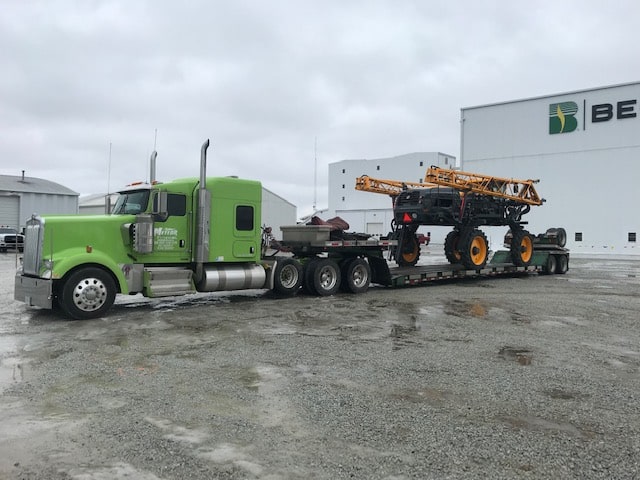
truck on a lowboy trailer

Transport Your Trailers Today

Heavy Equipment Transport is always available for a quote. Fill out the form or give us a call now! (888) 730-2951

Dimensions of Common Trailers Used in Trucking and Delivery Services

Flatbed Trailers

A flatbed trailer is quite common, mainly because of its versatility in hauling and delivery of large and heavy equipment such as agricultural, construction, and industrial commodities. It is highly versatile, with a flat, open deck, no roof or sides. This makes it one of the most valuable assets for shippers. Ideally, a flatbed trailer transports heavy cargo which is not delicate, perishable, or vulnerable to external elements such as extreme heat and precipitation as they are open and offer no protection to the shipment. The open deck makes a flatbed trailer quite flexible and especially when loading and offloading. However, loading cargo onto this trailer will require additional equipment such as cranes and forklifts. Flatbed trailers are 48-53 feet in length, with their standard dock height being 5 feet from the ground. Flatbeds transport cargo that does not exceed 48,000 pounds in weight and 8ft.6 inches in both height and length—but can be expanded to 11″. They are also other common sizes designed for various uses. They include 24, 40, 45, and 53 ft. flatbeds.

Step Deck Trailers

Also known as a drop deck trailer, a step-deck trailer is a piece of open deck hauling equipment designed with two deck levels- the upper (step) and the lower (main) deck. Ideally, the main deck will drop down after the tractor unit has been cleared. These trailers can haul taller shipments than flatbed trailers, as they are much closer to the ground. They also have ramps to facilitate safe and easy offloading and have proven safer for forklift pickup, given their short distance from the ground. You can use load levelers when you need to even out the main deck with the step deck. All the same, note that there are specific loads that cannot be loaded and shipped on a step-deck trailer even when load levelers are available. Unlike flatbed trailers, which can be loaded and unloaded from any side, step deck trailers can only be loaded or unloaded from the sides or the top. The main deck of a step-deck trailer is 3ft. 6 inches from the ground, while the step deck (top deck) is 4 feet from the ground. Step-deck trailers measure 53 feet in length—the step deck measure 10″ while the main deck measures 43″. This type of trailers is designed to transport cargo of height up to 10 feet, 2 inches before they are legally considered as over-dimensional.

Double Drop Trailer

If your load is too tall to ship on a step-deck trailer, a double-deck trailer can come in handy. A drop deck trailer will lower the center of gravity much more than a step-deck trailer facilitating easy transportation of extra tall cargo. It is, therefore, the best option if you plan on shipping an oversized shipment that is over 10 feet. Its main deck (the well) is in the middle. Like a step-deck trailer, a double-deck trailer can only be loaded and unloaded either from the top or side, but never from the rear. This trailer type measures 28-29 feet on the main (middle deck). If you are unsure of the best trailer type for your cargo, seeking the insights of heavy hauling experts would go a long way. A company such as Heavy Equipment Transport will guide you on how to customize your trailer with brilliant accessories and options that will make moving your shipment faster, fun, and trouble-free.

Tandem vs. Spread Axles in Trucking

Tandem vs. Spread Axles in Trucking

Heavy Equipment Transport Logo
Facebook
Twitter
LinkedIn

William Thomas / January 2021

Tandem Axle Trailer for Heavy Equipment Trucking

By definition, tandem simply means a set of items arranged one after or behind the other. In heavy hauling and trucking, tandem configuration means a truck or a trailer with close coupled pairs of single or multiple axles.

When compared to a single-axle trailer, a tandem axle trailer offers smooth trucking down a straight path. The tandem axles provide a large surface area with better shock absorption, which maintains the stability of the cargo by producing less shock.

How do Spread Axle Trailers Differ?

A spread axle provides a more stable configuration during loading and unloading of the heavy equipment. Spaced axles offer a significant weight distribution leeway compared to closed spaced axles due to the large wheel base brought about by the spread. Since the spread axles can support weight over a more extended area, spread axle trailers are easier on the trucking vehicle; as a result, towing is smooth. The same applies to balancing; spread axles are easier since the load can be distributed over a large area. And since axles that are 8 ft. apart can be legally considered as separate units each carrying 20,000 lbs. balancing on the scale becomes even much easier.

When compared to a single-axle trailer, a tandem trailer offers smooth trucking down a straight path. The tandem axles provide a large surface area with better shock absorption, which maintains the stability of the cargo by producing less shock.

Dump trailer transport

Transport Your Tandem or Spread Axles Today

Heavy Equipment Transport is always available for a quote. Fill out the form or give us a call now! (888) 730-2951

Which is Better for Trucking and Heavy Cargo Towing?

With all pros, the spread axle trailers come with they are still less popular compared to tandem axles trailers, and for good reasons. Both have 12,000 lbs loading capacity of steer axle, 34, 000 lbs capacity for drive axles, and when spread over 8 feet, the spread axle trailer can have a capacity of 86, 000 lbs., both the spread axle and tandem axle trailer has a legal limit of 80, 000 lbs. The only advantage the spread axle will have with the extra 6,000 pounds’ capacity is the ease of balancing the load. But the spread makes the trailer harder to turn, resulting in faster wear and tear of the axles, tires, and the suspension system, not to mention the difficulties the extra length pose during turning and maneuvering of the towing tractor.

The frame of a spread axle trailer has to be studier, making the overall trailer heavier. This leads to lower carrying capacity for the trailer. The increased wheelbase also makes it harder to back up. As evident, a tandem axle trailer doesn’t have a long list of pros like the spread axle trailer does, but neither does it have a much longer list of cons, like the spread axle trailer does. Both the trailers have a legal gross weight limit of 80, 000 lbs, but the tandem is easier to maneuver, easy on wheels, axle, and suspension, and excellent to back up, this makes the tandem axle trailer much suited for short trucking of heavy loads across cities and spread axle trailers are best for delivering heavy equipment over a long distance.

Transporting a 1997 Enclosed Trailer | Heavy Equipment Transport

Transporting a 1997 Enclosed Trailer with HET

Heavy Equipment Transport Logo
Facebook
Twitter
LinkedIn

William Thomas / May 2022

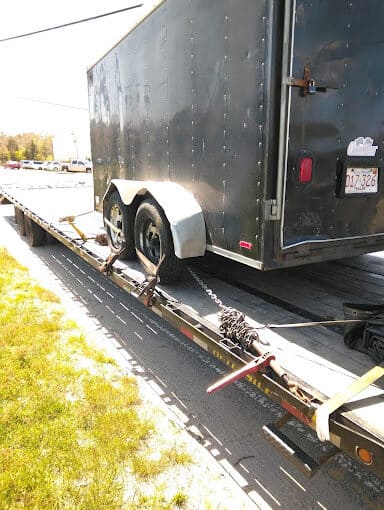
A client hired us to transport a 1997 enclosed trailer from Kingston, MA, to Charleston, SC. Nick H, one of our most experienced heavy equipment specialists, was the one to process the shipment. Our client wanted the 1997 enclosed trailer transported the following day. He used it as storage for his mower, moped, and tools. He had gotten a job in Charleston, SC, and needed to relocate with it immediately. With a deadline to beat, Nick H immediately started taking care of the paperwork needed. He also fully insured the  1997 enclosed trailer. Heavy Equipment Transport only uses professional specialists with years of experience. They must know how to ensure every shipment is successful. They also know the trailers to recommend based on the specifications of the heavy equipment being transported

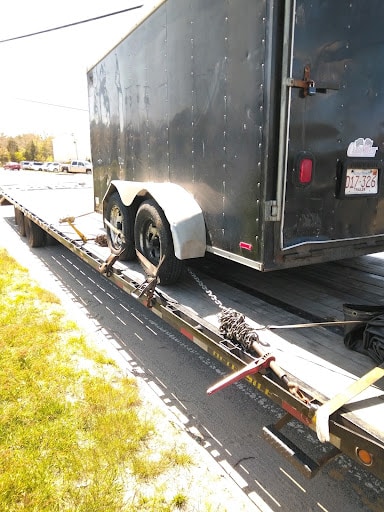
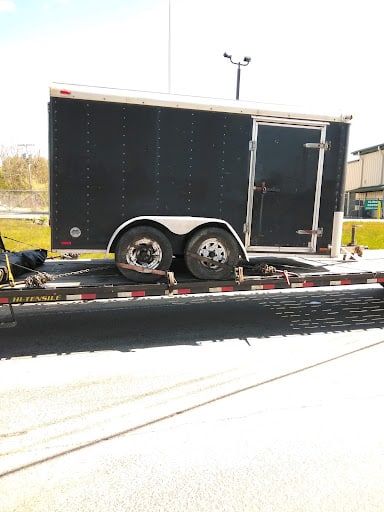
enclosed trailer on a trailer

Transport Your 1997 Enclosed Trailer Today

Heavy Equipment Transport is always available for a quote. Fill out the form or give us a call now! (888) 730-2951

Specialized 1997 Enclosed Trailer Shipping Services

After looking at the specifications of the 1997 enclosed trailer, he decided a flatbed trailer would be the most suitable to ship it. A flatbed trailer is big enough to transport the 12L 6W 8H 1997 enclosed trailer without a problem. When Nick H confirmed everything was ready, he called one of our drivers in Kingston, MA and scheduled to have the heavy equipment transported early the following day. He had also sent one of our loading professionals to help load the 1997 enclosed trailer safely. By the time Nick H was getting in the office the following day, our driver and the professional had already loaded the heavy equipment safely and secured it using chains.

Shipping a 1997 Enclosed Trailer Safely and on Time

As soon as our driver called Nick H telling him the loading process was successful, he was dispatched. With about 996 miles to cover, route I-95 S was the most convenient.  He stopped a couple of times and tightened the chains. After about 16 and a half hours, he was at the drop off location. He found another professional waiting for him to help unload the heavy equipment. The unloading process was successful. To transport heavy equipment, contact us at (888) 730-2951. 

William Thomas

William Thomas

Heavy Transport Specialist

Being able to lead a team of such talented logistics agents has been a wonderful experience over the past ten years. If you would like to know anything more about the heavy equipment transport services we offer, don't hesitate to give us a call!

Why Are Lowboy Trailers Popular for Heavy Equipment Transport

Why are Lowboy Trailers Popular for Heavy Equipment Transport

Heavy Equipment Transport Logo
Facebook
Twitter
LinkedIn

William Thomas / January 2021

A lowboy trailer is one of the most common trailers in the heavy transport and trucking industry. It has the characteristics of a semi-trailer and a double-drop system combined. The first drop is located right behind the gooseneck, while the other is situated before the wheels. Ideally, they are used to ship heavy equipment and machinery, including tractors, excavators, backhoe loaders, bulldozers, among other heavy loads. These trailer types are more flexible than flatbeds and can accommodate heavy loads of up to 12 feet in height, weighing 40,000 to 80,000 pounds. That means that they can effortlessly transport and deliver loads too tall and heavy to haul in a flatbed trailer. These trailer types are also incredibly compatible with other loads making them perfect options for carriers in the agriculture, construction, oils and gas, and forestry industries.

Lowboy trailer decks can be lowered closer to the ground, facilitating the easy loading of such oversized loads as construction equipment. Besides, they can either be loaded from either the front or rear, depending on the lowboy trailer type chosen. Alternatively, shippers might decide to place the trailer under the shipment then lift it for easy and safe loading.

Lowboy Trailer Maximum Dimensions

    • The maximum low bed well length is between 4 to 26.6 feet
    • The maximum legal width is 8.5 feet
    • The maximum lowboy well height is between 18 to 24 inches
    • The maximum legal freight height is between 11.5 to 12 feet
    • Their maximum legal overall load height is 14 feet
    •  

    A lowboy trailer must comply with these dimensions as specified by the Federal size regulations. Failure to do this can attract hefty fines and even lead to unnecessary delays.

truck on a lowboy trailer

Transport Your Lowboy Trailer Today

Heavy Equipment Transport is always available for a quote. Fill out the form or give us a call now! (888) 730-2951

Reasons Lowboy Trailers Popular in the Heavy Equipment Transport

  • Stability – Ideally, lowboy trailers have a low center of gravity. This makes it more stable while delivery of heavier farm equipment transports compared to other trailers. Besides, they come with a broader cargo plane which means that you can rely on these trailers to keep your shipment safe throughout the transit.
  •  
  • Versatility – As aforementioned, lowboy trailers come in an incredibly versatile design. As such, they can seamlessly haul even the heaviest shipments without compromising the driver’s, cargo, or shipping equipment safety standards. Besides, these trailers have a low profile, making it easy for them to comply with height restrictions, facilitating cargo transportation from one point to another with no legal issues.

Common Types of Lowboy Trailers We Use for Heavy Equipment Trucking

Fixed Gooseneck Lowboy Trailers

These types of lowboy trailers have the lightest deck and a more extended deck. They have low-profile tires, sit lower to the ground, and are usually equipped with drop ramps at the rear for easy loading. However, given their fixed style, loading items on this trailer might appear more challenging than other types, such as removable goosenecks.

Removable Gooseneck Lowboy Trailers

This trailer is highly versatile, making it the most commonly used lowboy trailer for heavy equipment transport. It is a perfect option when hauling motorized equipment. This is because of its style, making it easy to drive, roll, push or pull such cargo types onto the trailer bed. Alternatively, you can load cargo from the top when necessary. These lowboy trailers have detachable goosenecks, which can be removed to create a ramp facilitating easy loading and offloading. The gooseneck can either be mechanically detachable or hydraulic detachable. The hydraulic detachable types are pretty easy to detach and make it easy to adjust the height of the trailer. However, they require more specialized care and maintenance than their counterparts due to their hydraulic systems.

Three Types of Trailers for Heavy Equipment Transport

Three Types of Trailers for Heavy Equipment Transport

Heavy Equipment Transport Logo
Facebook
Twitter
LinkedIn

William Thomas / January 2021

Flatbed Trailer Transport

A flatbed trailer comes in different sizes ranging from 48 feet to 53 feet—though the most common is 48 feet. Standard flatbeds are designed to can tow heavy equipment that weighs to 48000 pounds. The maximum height and width for a flatbed is 8.5 feet. It is usually 60 inches from the ground.

When to Use Flatbed Trailer Trucking For Heavy Equipment Transport

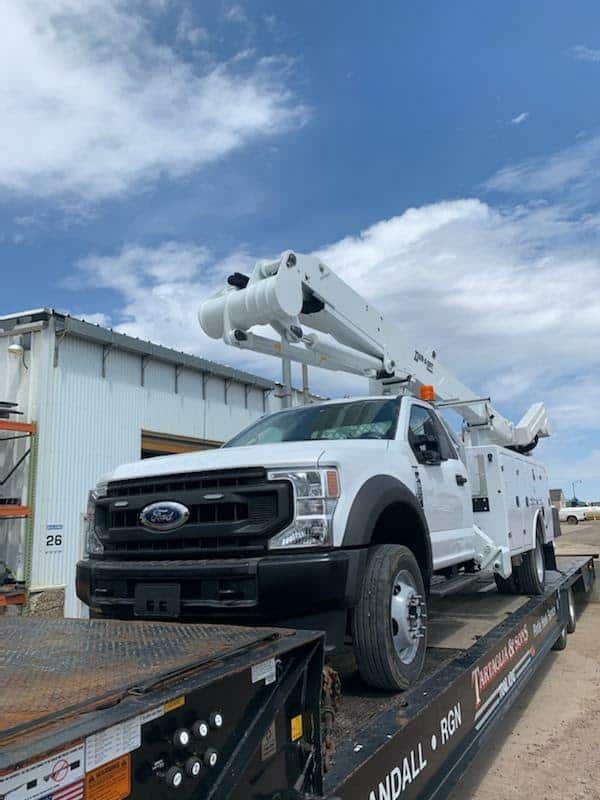
Ford utility truck on step deck trailer

Flatbed trailers are very versatile and, as such, are the most used types of trailers in the trucking and shipping industry. They can be used to transport different sizes of loads. Flatbed trailers are open from all sides, and this makes loading and offloading so easy. For instance, a crane can be used to pick the load from the top or a fork lifter from any of the sides. If you have an oversize cargo transport with an irregular shape and height, Heavy Equipment Transport has different flatbed trailers to seamlessly move your cargo from point A to point B. Since it is very open, we can secure your load with tarps, and tied own traps for safe delivery and protection against weather elements.

Advantages of Using a Flatbed Trailer for Delivery of Overweight Loads

  • • Since a flatbed trailer is open from all sides, it easy to work with when loading and offloading oversize loads or cargo with unique shapes. You don’t have to be scared of bumping into walls and causing damage. 
  •  
  • • Being an open-air trailer, a flatbed can be used to ship literally anything!
  •  
  • • Flatbeds tough and reliable for heavy trucking such as airplane parts and mobile homes.
  •  
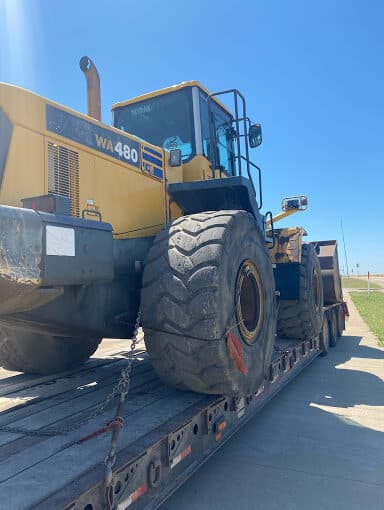
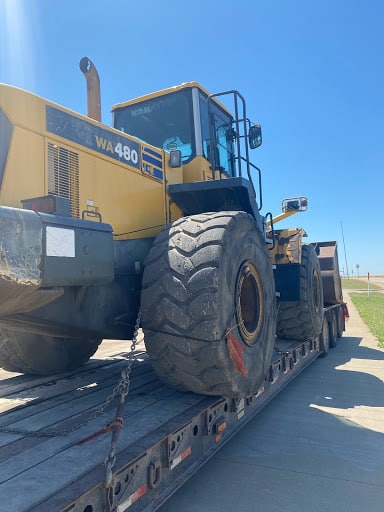
wheel loader on lowboy trailer

Transport Your Heavy Equipment Today

Heavy Equipment Transport is always available for a quote. Fill out the form or give us a call now! (888) 730-2951

Step Deck Trailer Transport

Step deck trailer carries up to 48000lbs. Its lower deck is 37 feet by 8.5 feet, while its upper deck is 11 feet by 8.5 feet. The lower deck’s maximum height is 10 feet, while that of the upper deck is 8.5 feet.

When to Move Your Cargo Using a Step Deck Trailer

Just as the name suggests, a step deck trailer has two deck levels: an upper deck and a lower deck. The main difference between step deck trailers and flatbed trailers is the maximum legal height it can carry. If the equipment you intend to move cannot fit on the flatbed trailer because of height, the step deck trailer is the next great option. A step deck trailer is closer to the ground, and as such, provides a few extra inches for taller loads.

Advantages of Step Deck Trailer Towing and Shipping

  • • You can place the cargo with a few extra inches lower down the step deck and save yourself the hassle of seeking height permits
  •  
  • • A step deck trailer is closer to the ground compared to a flatbed trailer, and forklifts can be used to quickly and safely load and offload them
  •  
  • • Step deck trailers can easily be loaded with large cargo because they are close to the ground. They are the perfect trailers for large loads.


When to Use a RGN for Heavy Equipment Towing

Moving large equipment is cumbersome. Additionally, you need height permits to truck tall loads. The RGN trailer has a dropped region in the middle known as the “well”. It is perfect for carrying taller objects. With this well, you save yourself the hassle of looking for height permits because they can fit there well without exceeding the legal maximum height that a standard trailer is permitted to haul. Besides, the front end of the Removable Gooseneck Trailer is detachable, which makes loading and offloading from either end fast and convenient—you can directly drive a massive piece of equipment such as a bulldozer into the trailer.

Benefits of Moving Tall and Oversize Cargo with RGN Trailers

  • • A Removable Gooseneck Trailer saves you time you could have otherwise spent when seeking for height permits to transport bigger equipment across interstates.
  •  
  • • With a RGN, you don’t need other large pieces of machinery to help load and unload the trailer since you can drive in the equipment you intend to tow.

Choosing The Best Trailer for Transport

When it comes to transporting heavy machinery, you need to work with the experts. Heavy Equipment Transport determines the best trailer to haul your equipment with ease. We are here any time you need to move heavy equipment, and our expert logistics agents will find the best shipping solutions to fit your needs. Let’s get started! (888) 730-2951