
How to Choose The Best Trailer for Shipping Equipment

How to Choose The Best Trailer for Shipping Equipment

Heavy Equipment Transport Logo
Facebook
Twitter
LinkedIn

William Thomas / January 2021

To properly transfer your equipment, one of the most crucial factors is picking the right trailer. The last thing you want is to risk choosing the wrong trailer, leading to damage to your expensive equipment. Read on to learn more about choosing the best trailer for shipping equipment.

Flatbed Trailers
The Best Trailers for Compact Equipment

Flatbed trailers can be found in lengths between 48 and 53 feet, with the former being the more common option. Towing capacities of standard flatbed trailer transports typically top out at 48,000 pounds. A flatbed can be no more than 8.5 feet in height or breadth. A flatbed trailer is usually sixty inches off the ground.

The transportation and shipping industries rely heavily on flatbed trucks because of their adaptability. They’re versatile enough to haul loads of varying sizes. Because of their open design, loading and unloading from and onto flatbed trucks is a breeze. A crane can raise the weight from above, or forklifts can access the load from the sides.

Flatbed trailers are the best trailers for oversize loads with irregular shapes and heights. Due to their open layout, tarps and tied own traps can be used to keep your shipment dry and secure throughout the transport.

Benefits of Flatbed Trailer Transport

A flatbed, being an open trailer, can transport anything. Its open design makes it practical for transporting irregularly shaped or oversized items. You don’t need to worry about banging into walls and breaking anything.
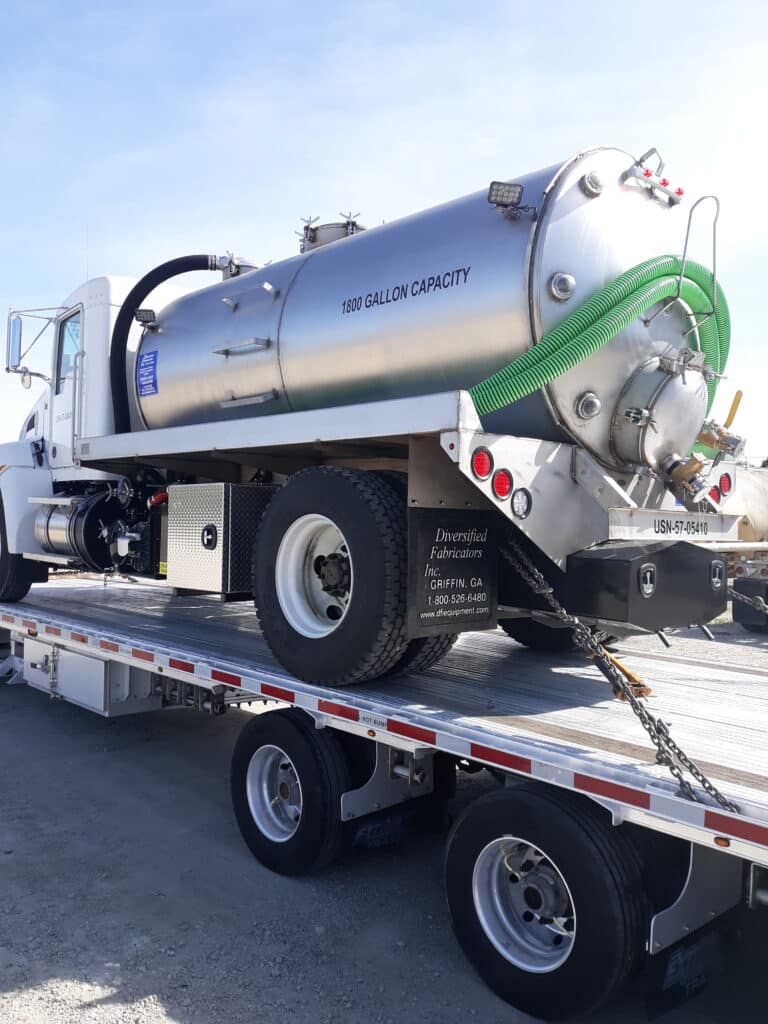
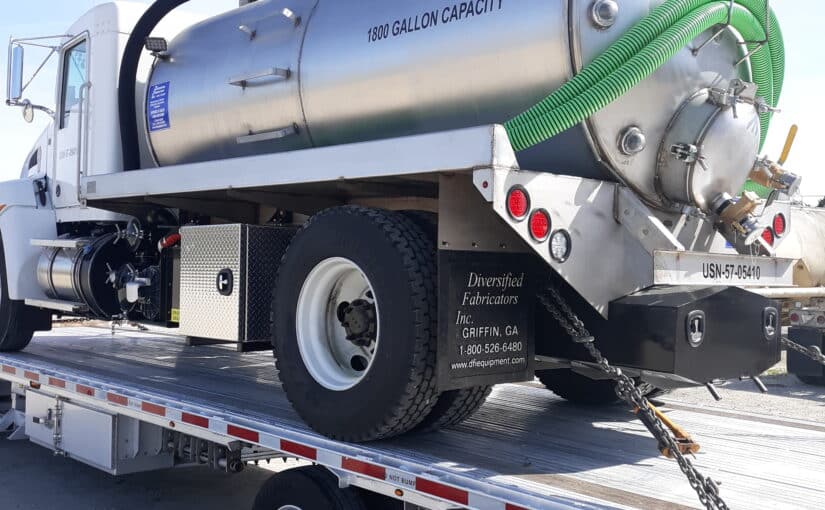
Transporting a vacuum truck on a flatbed trailer.

“Knowing the make, model, and dimensions of your heavy equipment helps determine the best trailer for transport.”

Step-Deck Trailers
The Best Trailers for Partial Loads

A step-deck trailer’s maximum payload capacity is 48,000 pounds. The maximum height for cargo is 10 feet, while the width is eight and a half feet. A standard length for a step-deck trailer is 48 feet. A step-deck trailer has a well that is 37 feet long and a deck that is 11 feet long.

Step deck trailer transports sit lower to the ground than flatbed trailers. Smaller pieces of self-propelled machinery may be driven up the ramps with a step-deck trailer. Step deck trailers have a well almost a foot lower than the deck of a flatbed trailer, allowing for the carriage of equipment that barely exceeds the height limitations on a flatbed. It is possible to utilize a step deck trailer as an alternative to a flatbed trailer if the intended cargo is too tall to fit on the latter. Equipment too tall to ship on flatbed trailers typically travels as a partial load on step-deck trailers.
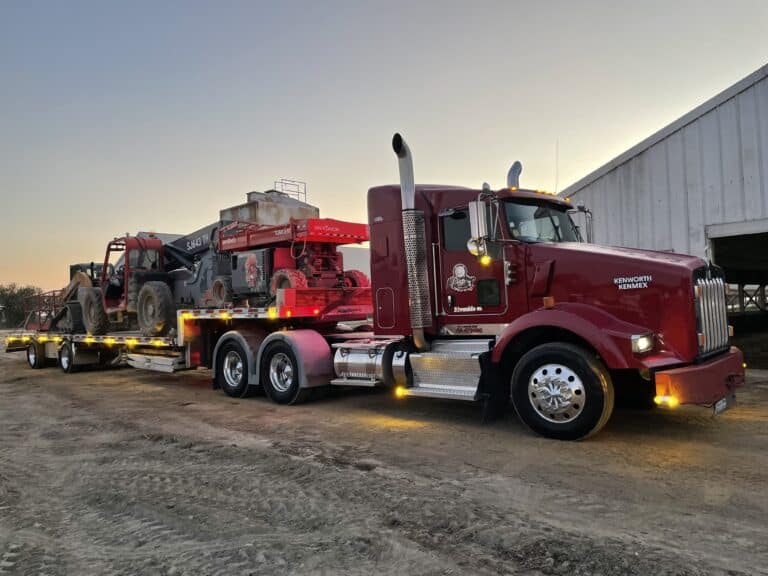
Transporting multiple heavy equipment on a step deck trailer

Transport Your Equipment Today

Heavy Equipment Transport is always available for a quote. Fill out the form or give us a call now! (888) 730-2951

Benefits of Step-Deck Trailer Transport

You can avoid the headache of obtaining height permits by stowing your cargo a few inches lower on the step deck.

Because of their low loading height, step deck trailers are ideal for transporting heavy or bulky items. They are the perfect trailers for oversize loads.

RGN Trailers
The Best Trailers for Oversize Loads

You may load up to 42,000 pounds into an RGN trailer. The RGN trailer’s low-sitting well allows it to transport items up to 11.5 feet in height. The typical width of an RGN trailer is eight and a half feet. In most instances, the length of the well is 29 feet.

For heavy, self-propelled equipment, RGN trailer transports are your best bet. This heavy equipment may weigh up to 80,000 pounds, so the RGN’s drive-on/drive-off capability is essential for safe transport. On top of that, RGN trailers have around 1.5 feet of additional headroom than step-deck trailers.

Choosing The Best Trailer for Shipping Equipment

Hauling Capacity

To calculate a vehicle’s towing capacity, you must first determine its empty weight and then add the weight of everything you plan to transport. Even though you may be able to fit more items inside the truck’s bed, you should never do so. This is because legal and structural safety restrictions dictate a trailer’s hauling capacity.

Type of Equipment Being Hauled

You must be familiar with the machinery you will be transporting. For example, an ATV deck over won’t look the same as one for a vehicle. Knowing what you’re hauling will give you a better idea of what you require.

Selecting the proper trailer is the first step in ensuring your machinery’s safe and effective transport. You need to find the most practical solution at the lowest possible cost.

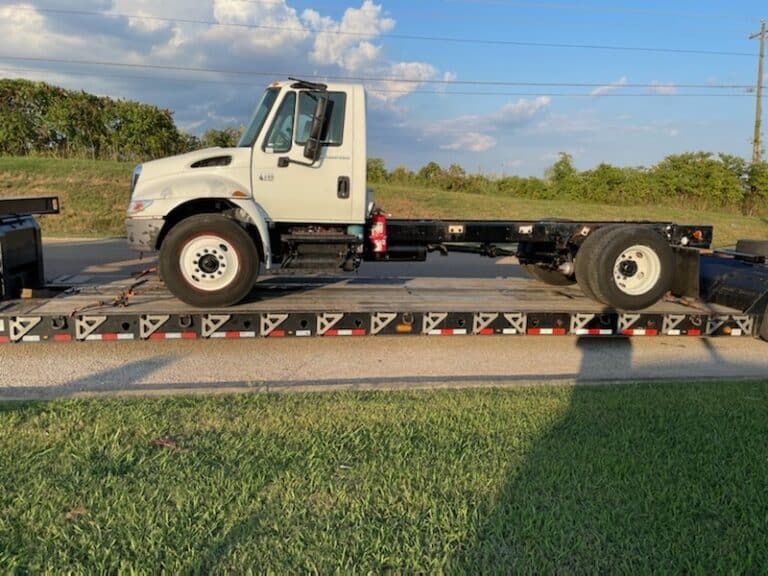
The Most Popular Equipment Transport Trailers + Their Dimensions

The Most Popular Equipment Transport Trailers + Their Dimensions

Heavy Equipment Transport Logo
Facebook
Twitter
LinkedIn

William Thomas / January 2021

The Most Popular Heavy Equipment Transport Trailer and Their Dimensions

Heavy Equipment Transport trailers come in different types and dimensions. That said, understanding their distinct specifications will help you determine the right trailer that needs the unique needs hauling and transporting your cargo. Each trailer type is specially tailored to meet different hauling needs. Sometimes, choosing the right one for your specific load can be quite challenging, especially if you are not an experienced shipper. Having a reputable shipping company by your side will guarantee you a safe and stress-free heavy equipment hauling and delivery experience. Besides being top-of-the-line logistics experts, such companies as Heavy Equipment Transport have invested in quality shipping trailers to cater to your shipping needs. Some of the most common trailer types used in the shipping industry includes:

List of Most Common Trailers Heavy Equipment Transport Uses to Haul Over-Dimensional Equipment

  • Flatbed Trailers
  • Removable Gooseneck (RGN) Trailers. (Both Standard and Expandable RGN)
  • Double Drop Trailers
  • Lowboy Trailers/ Double Drop Trailers
  • Refrigerated (Reefers) Trailers
  • Step-Deck Trailers/ Drop Deck Trailers
  • Tilt Trailers
  • Dry Van Trailers
truck on a lowboy trailer

Transport Your Trailers Today

Heavy Equipment Transport is always available for a quote. Fill out the form or give us a call now! (888) 730-2951

Dimensions of Common Trailers Used in Trucking and Delivery Services

Flatbed Trailers

A flatbed trailer is quite common, mainly because of its versatility in hauling and delivery of large and heavy equipment such as agricultural, construction, and industrial commodities. It is highly versatile, with a flat, open deck, no roof or sides. This makes it one of the most valuable assets for shippers. Ideally, a flatbed trailer transports heavy cargo which is not delicate, perishable, or vulnerable to external elements such as extreme heat and precipitation as they are open and offer no protection to the shipment. The open deck makes a flatbed trailer quite flexible and especially when loading and offloading. However, loading cargo onto this trailer will require additional equipment such as cranes and forklifts. Flatbed trailers are 48-53 feet in length, with their standard dock height being 5 feet from the ground. Flatbeds transport cargo that does not exceed 48,000 pounds in weight and 8ft.6 inches in both height and length—but can be expanded to 11″. They are also other common sizes designed for various uses. They include 24, 40, 45, and 53 ft. flatbeds.

Step Deck Trailers

Also known as a drop deck trailer, a step-deck trailer is a piece of open deck hauling equipment designed with two deck levels- the upper (step) and the lower (main) deck. Ideally, the main deck will drop down after the tractor unit has been cleared. These trailers can haul taller shipments than flatbed trailers, as they are much closer to the ground. They also have ramps to facilitate safe and easy offloading and have proven safer for forklift pickup, given their short distance from the ground. You can use load levelers when you need to even out the main deck with the step deck. All the same, note that there are specific loads that cannot be loaded and shipped on a step-deck trailer even when load levelers are available. Unlike flatbed trailers, which can be loaded and unloaded from any side, step deck trailers can only be loaded or unloaded from the sides or the top. The main deck of a step-deck trailer is 3ft. 6 inches from the ground, while the step deck (top deck) is 4 feet from the ground. Step-deck trailers measure 53 feet in length—the step deck measure 10″ while the main deck measures 43″. This type of trailers is designed to transport cargo of height up to 10 feet, 2 inches before they are legally considered as over-dimensional.

Double Drop Trailer

If your load is too tall to ship on a step-deck trailer, a double-deck trailer can come in handy. A drop deck trailer will lower the center of gravity much more than a step-deck trailer facilitating easy transportation of extra tall cargo. It is, therefore, the best option if you plan on shipping an oversized shipment that is over 10 feet. Its main deck (the well) is in the middle. Like a step-deck trailer, a double-deck trailer can only be loaded and unloaded either from the top or side, but never from the rear. This trailer type measures 28-29 feet on the main (middle deck). If you are unsure of the best trailer type for your cargo, seeking the insights of heavy hauling experts would go a long way. A company such as Heavy Equipment Transport will guide you on how to customize your trailer with brilliant accessories and options that will make moving your shipment faster, fun, and trouble-free.