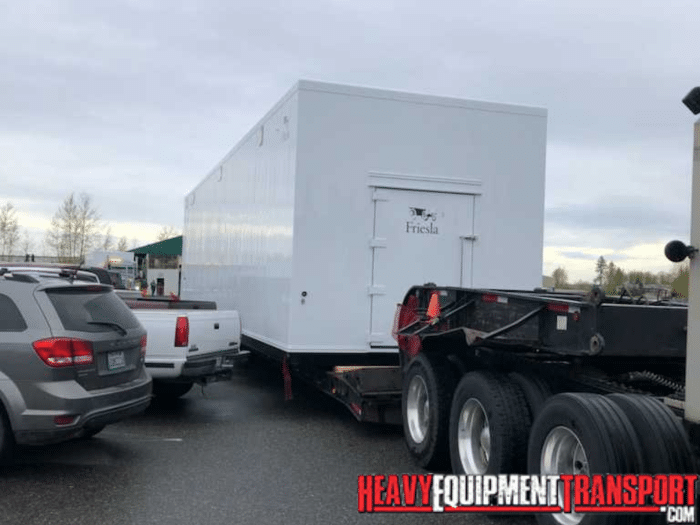
What Type of Trailer Do You Need to Ship a Container?

What Type of Trailer Do You Need to Ship a Container?

Heavy Equipment Transport Logo
Facebook
Twitter
LinkedIn

Francisca Olive / July 2023

There are several types of trailers to choose from when transporting shipping containers, including flatbeds, goosenecks, and chassis. While each type has its advantages, the chassis trailer has become the go-to option for many shipping companies and container movers. This article will explore why the chassis is the best shipping container transport trailer.

What Is a Container Chassis?

A chassis (or skeletal trailer) is a wheeled trailer structure designed to carry many different kinds of containers (standard and special). These metal frames are built to transport containers from one terminal to another, as well as between warehouses, ports, and other warehouses. There are different types of container chassis, so you can choose the one that best fits your needs.

A container chassis is essentially a steel frame with tires and axles connected. The capacity of a chassis depends mainly on its axles. The axle is the lengthy shaft connecting the wheels. A regular chassis can haul 20-foot and 40-foot containers with only two axles. A tri-axle chassis is required to transport 20ft containers weighing more than 36,000 pounds or 40ft containers weighing more than 44,000 pounds.
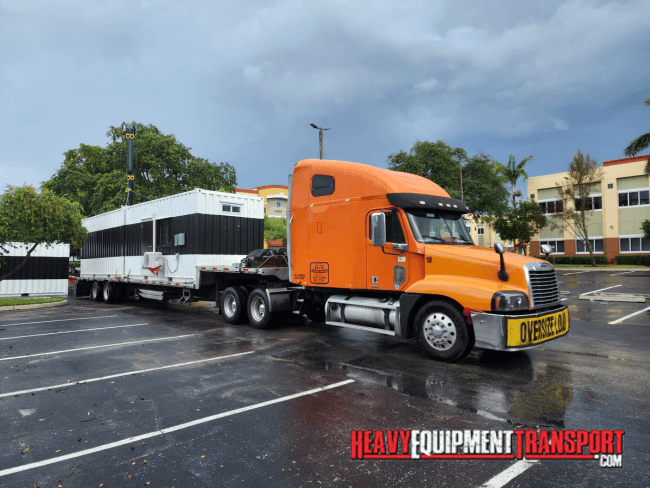
container haul

Transport Your Container Today

Heavy Equipment Transport is always available for a quote. Fill out the form or give us a call now! (888) 730-2951

What Makes the Chassis the Best Shipping Container Transport Trailer?

The purpose of a chassis is to move shipping containers quickly and safely. They’re sturdy and strong, shielding containers from shocks and vibrations on the road. Containers are fastened safely and securely to the chassis, eliminating the need for excessive container movements and making transportation significantly safer.

Although typically constructed of lightweight materials, a container chassis is strong enough for heavy equipment transport. They also come in various types so that transport companies can choose the best for their needs.

Types of Container Chassis

➤ Common Chassis

The common chassis does not provide any customization options. It’s just a simple, permanent structure designed to move containers from one location to another. These chassis require the use of overhead cranes for loading and unloading freight.

Standard 20-foot, 40-foot, and 45-foot containers can be transported using the common chassis. Distinctive body markings indicate where your containers should go. This chassis is not only inexpensive but also easy to operate. However, external equipment, such as overhead cranes, may result in additional costs.

➤ Tilt Container Chassis

Because of the nature of this chassis type, loading and unloading containers is a breeze. A tilt chassis, as opposed to a common chassis, features upper and lower frames. The upper structure may tilt upward using hydraulics. In addition, the chassis’ upper frame includes a roller that links to the bottom frame.

This setup ensures a safe and manageable loading and unloading process. You’ll have to shell out more cash for this one, but if ease of use is your top priority, it’s worth it.

➤ Extendable Chassis

As their name suggests, extendable chassis can be adjusted to accommodate various containers. This type of chassis functions in much the same way as a common chassis, with one key distinction. Because the back can be extended, it can be used for various purposes.

This is the chassis for container movers transporting containers of various lengths.

Choosing the Right Chassis Trailer for Your Needs
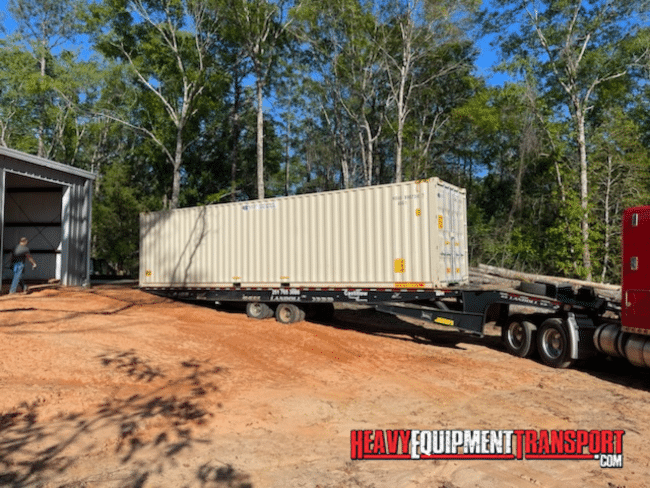
container haul

Which chassis is best for you depends solely on your needs. The following should be taken into account when deciding the type to go with:

➤ Usage

A container-specific chassis is the best option if you need to move containers. On the other hand, flatbed chassis trailers are the best option if you need to transport containers along with other goods. A tilt chassis is convenient if you have to load and unload items in specific locations since it eliminates the need for renting a crane or other lifting machinery.

➤ Weight Threshold

You can select the number of axles in the chassis best to accommodate the weight of the container. The more axles a chassis has, the more weight it can carry. The ideal option for moving conventional containers is a two- or three-axle chassis.

➤ Cost

Before deciding on a chassis, consider the container’s requirements and specs carefully. You should expect to pay more for a customized chassis than a standard one. Hence, when you look for a container chassis, you should ensure that you completely understand your requirements.

Key Takeaway

A container chassis is the most effective shipping container transport trailer. These trailers are built for container hauling. Because there is such a large selection of trailers to choose from, you can pick the one that’s most appropriate for your needs.

William Thomas

William Thomas

Heavy Transport Specialist

Being able to lead a team of such talented logistics agents has been a wonderful experience over the past ten years. If you would like to know anything more about the heavy equipment transport services we offer, don't hesitate to give us a call!
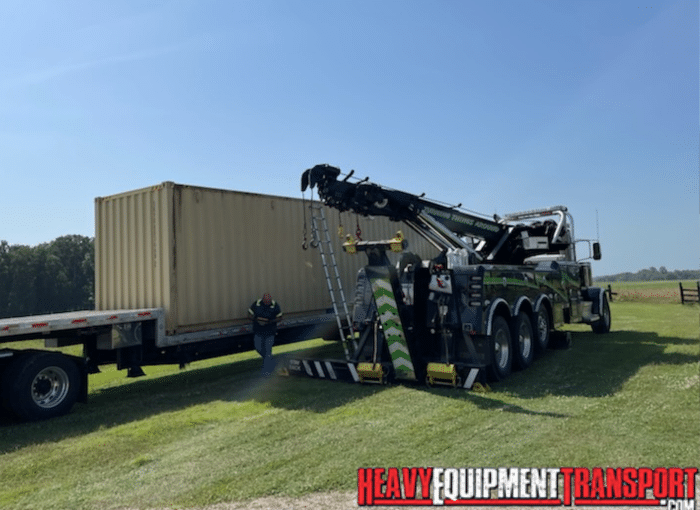
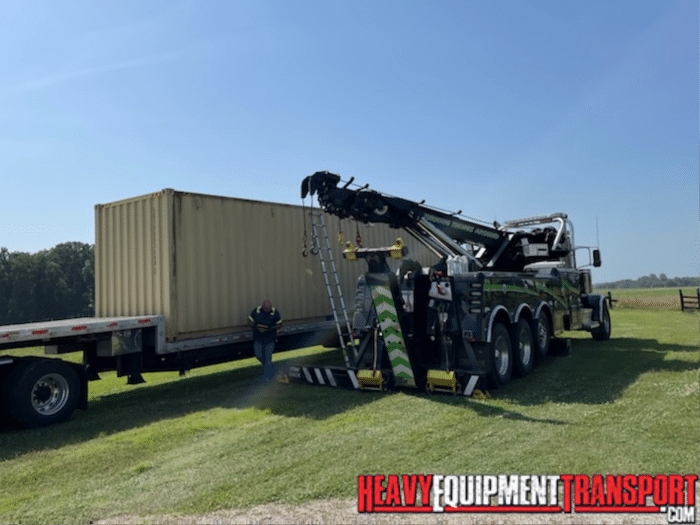
The Cheapest Way to Move a Shipping Container

The Cheapest Way to Move a Shipping Container

Heavy Equipment Transport Logo
Facebook
Twitter
LinkedIn

Francisca Olive / May 2023

Although moving a shipping container might be pricey, there are ways to accomplish it on a budget. This article will explore the cheapest ways to move a shipping container so that you can choose the best option for your budget and needs.

The Cheapest Way to Move a Shipping Container: Sea Freight

container on trailer for transport

Ocean freight is the cheapest way to move a shipping container. Before the invention of air freight, sea freight was the only method of overseas transport.

Affordability

Sea freight is the most cost-effective mode of transportation, regardless of the number of items transported. Barges can move vast quantities of packaged goods or bulk commodities across short or long distances at a cost unmatched by any other form of transportation.

LCL services allow freight forwarders to divide container moving costs amongst their clients, allowing them to offer affordable shipping for smaller items such as cases, bottles, pallets, or even drums and IBCs.

On the other hand, the maritime freight business can face chaotic and unprecedented situations, such as port congestion, a lack of shipping containers, delays at customs, and several other issues.

Other Benefits of Sea Freight

When it comes to reducing emissions, sea freight is unrivaled.

Although sea travel is often slower and more susceptible to weather-related delays, it has a greater range. As there is usually a port of entry close by, it is now possible to ship goods anywhere in the world by sea.

container on trailer for transport

Transport Your Container Today

Heavy Equipment Transport is always available for a quote. Fill out the form or give us a call now! (888) 730-2951

Air Freight

Air freight is the most efficient shipping option for urgent or perishable items. Typically, cargo aircraft fly at a speed of about 900 km/h. In addition, cargo planes often use straight flight paths, eliminating the potential for air traffic jams and boosting their unparalleled delivery speed.

As their shelf lives are short and security measures must be stringent, perishable goods and high-value commodities are ideal cargo for air transport. Compared to other transportation modes, the ability to swiftly and easily adjust flight routes in the event of poor weather results means a reduced risk of damage to the cargo.

However, air freight is the most expensive method of moving a shipping container. It is also the only other option (apart from sea freight) for shipping goods overseas, so if you want to ship perishable or urgent goods overseas, this is your best option.

Road TransporTation

Road travel is the second most popular mode of transportation and is the simplest and fastest way to handle domestic deliveries.

A portion of any container shipment will always involve vehicle transport. In addition to being the second most common method of transportation, it is also the most essential. Like ocean freight, it offers its clientele full truckload (FTL) and groupage/LTL services. Although there may be multiple points of contact during road transport, container moving costs may be lower, especially in the case of LTL shipping.

It is also easier to meet paperwork requirements while transporting a container by road, especially if the vehicles are not crossing international borders. Delivery times for goods traveling by road are often short, thanks to the abundance of transport firms offering a wide range of vehicle sizes.

Rail Transport

Rail freight is a cost-effective option for long-distance land travel. It is speedy, trustworthy, and safe, with few delays.

When transporting goods, the most pressing concern is getting a shipment to its destination on schedule and without any incidents. Because of this, it is crucial to choose a reliable mode of transportation. Rail transit meets this need. Because railway authorities closely control the capacity on the rails and trains are rarely affected by the weather, there is seldom a problem with traffic congestion. Trains do not stop very often, and most services go straight to their respective destinations.

Another area in which rail freight transportation shines is the high standard of safety it maintains for cargo. Cargo train thefts are pretty unusual. Because freight terminals and railways are typically safe sites with low crime rates, trains are the most reliable method for transporting goods cross country.

Furthermore, rail transportation is an eco-friendly option for land-based cargo operations. When it comes to conveying huge freight loads over numerous carriages and long distances, this form of transportation is more environmentally friendly than road transportation since most trains run on electricity, resulting in minimal CO2 emissions.

Key Takeaway

Sea freight is often considered the most cost-effective transport option. However, this varies depending on the volume of cargo being shipped. No one method of container shipping is inherently better than the others.

William Thomas

William Thomas

Heavy Transport Specialist

Being able to lead a team of such talented logistics agents has been a wonderful experience over the past ten years. If you would like to know anything more about the heavy equipment transport services we offer, don't hesitate to give us a call!